
When the Hip Feels “Locked”: Why Stretching May Not Be Enough
Disclaimer: The following case study is based on an individual treatment session. Identifying details have been changed to protect patient privacy. Individual results vary, and this article is intended for general education only.Sometimes a patient comes in with a problem that sounds quite simple.
“My hip feels tight.”
“My leg won’t rotate out properly.”
“I’ve stretched it, but it keeps coming back.”
On the surface, this may sound like a straightforward hip mobility issue. Many people would naturally think the answer is more stretching, hip strengthening, glute exercises, or perhaps some mobility work for the lower back.
But in the clinic, the body does not always follow a textbook pattern.
Recently, I saw a patient who felt that their left hip could not rotate outward properly. They had already been doing stretching exercises for some time. The stretching would sometimes give temporary relief, but the improvement did not last. Very quickly, the hip would feel restricted again.
This is a common frustration. When a muscle keeps tightening up again and again, it may not be because the muscle simply “needs more stretching”. Sometimes, the muscle is being held tight by another protective mechanism in the body.
The Problem Was Not Just the Hip
During the assessment, I noticed several small restrictions along the spine and pelvis. The hip itself was not the only area involved.
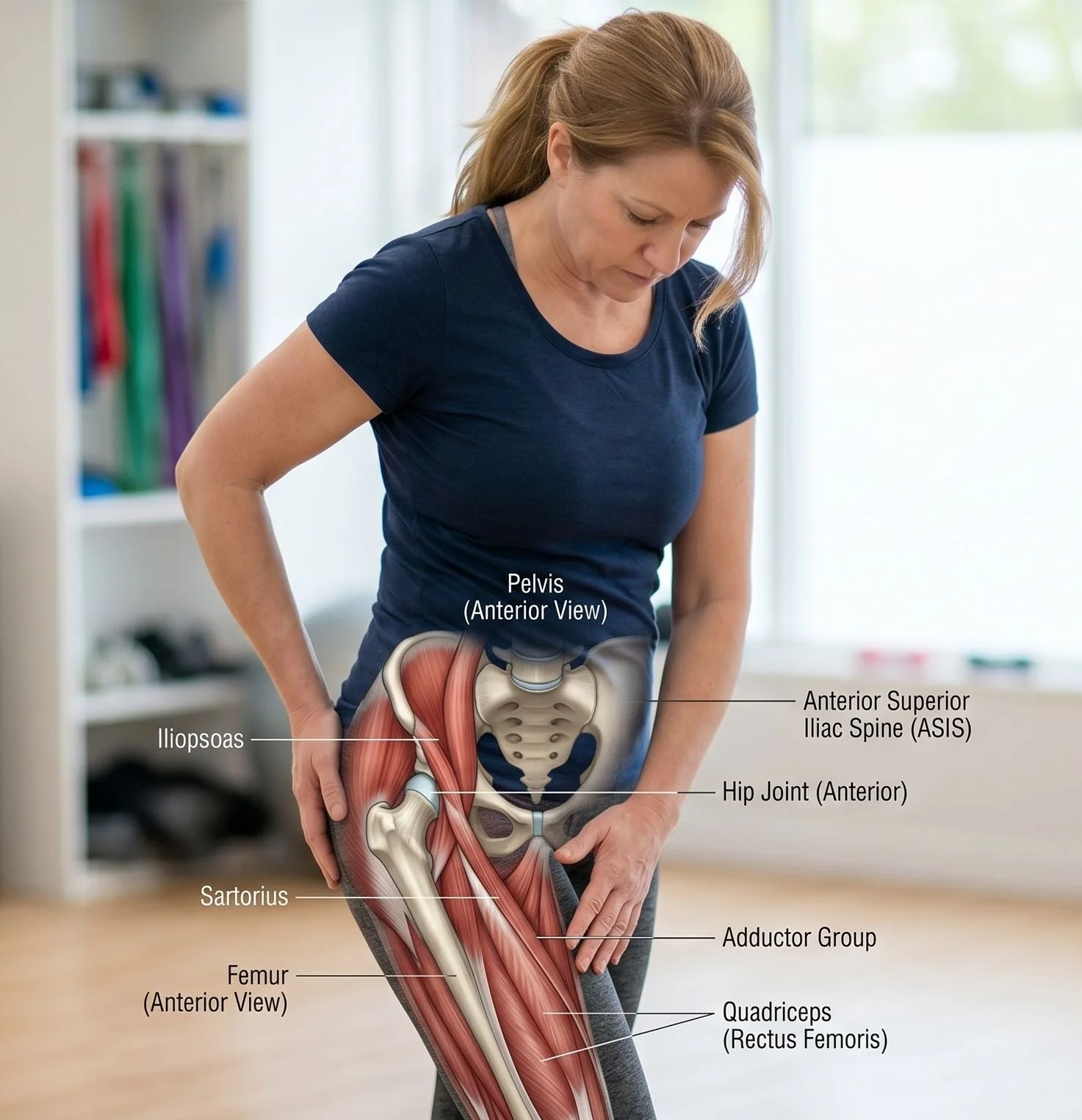
One of the interesting findings was that a muscle around the inner/front part of the hip (pectineus) was holding very tightly. This muscle assists with hip movement, including bringing the thigh forward and inward. In this case, it felt as though it was in a protective spasm.
There was no clear history of injury. The patient did not recall a specific incident, fall, strain, or accident that started the problem. It seemed to have developed gradually.
From a standard physiotherapy point of view, it would be reasonable to think about several possible causes, such as:
hip joint restriction
lower back stiffness
pelvic control issues
core weakness
glute weakness
pelvic floor involvement
nerve tension
These are all valid things to consider. However, in this particular case, the body was giving a different message.
The key question was not simply, “Which muscle is tight?”
The better question was:
Why is this muscle being held tight by the body?
Listening to the Body Through Hands-On Assessment
At Fascial Release Clinic, I use a detailed hands-on assessment process to help identify which tissues may be contributing to the patient’s symptoms.
When I assessed the patient’s general movement, there was no major limitation in standing movements. They could bend and turn reasonably well. However, when lying down, the left hip clearly resisted external rotation and some degree of abduction. The muscle around the inner/front hip region was strongly guarded.
I then assessed different spinal and pelvic areas using palpation, touch inhibition, and joint mobility testing.
What stood out was that the restriction was not primarily coming from the hip joint itself. It appeared to be linked with the pelvis, particularly around the left innominate bone. The innominate refers to the large pelvic bone on each side, made up of the ilium, ischium, and pubis.
In simple terms, the pelvis seemed to be involved in creating a reflexive holding pattern. This appeared to increase the tone of the hip muscle, making the hip feel as though it could not rotate outward.
So instead of forcing the hip to stretch, the treatment needed to address the deeper driver behind the muscle guarding.
Why Stretching Alone May Not Hold
Stretching can be useful. However, when a muscle is being held tight by a protective reflex, stretching may only give temporary relief.
It is a bit like trying to pull open a door while someone is holding it shut from the other side. You may be able to open it slightly for a short time, but unless you understand why it is being held shut, the problem may keep returning.
In this case, the hip muscle was not tight because it was simply short. It appeared to be overactive because the body was trying to protect or compensate for another restriction.
This is one reason some patients say:
“I stretch every day, but it keeps coming back.”
That does not mean they are doing the wrong thing. It may simply mean the body needs a different type of input.
The Treatment Approach
The treatment focused on reducing the relevant restrictions around the pelvis and related areas.
As usual, I did not stop at the first finding. When time allows, I like to assess and treat related systems that may be contributing to the overall pattern. In this session, treatment also included areas related to:
pelvic nerves
superficial fascia
spinal and pelvic mobility
neck-related autonomic nervous system findings
muscular restrictions around the neck
venous system restrictions related to the spine
This may sound surprising when the main complaint was the hip. However, the body often works as an interconnected system. A hip problem may not always be only a hip problem.
After the treatment, the patient’s hip external rotation improved significantly. The movement was not perfect immediately, but it was much easier than before.
When I reviewed the patient the following week, the hip was able to rotate outward fully, and the previous muscle guarding was no longer present.
Again, this does not mean every similar hip problem will respond in the same way. Each person’s body has its own history, compensation patterns, injuries, stress, posture, and movement habits.
But this case was a good example of why assessment matters.
What If We Only Treated the Obvious Area?
Looking back, if I had only used a more conventional reasoning model, I may have focused on:
core strengthening
pelvic floor activation
glute strengthening
lower back mobilisation
hip stretching
nerve gliding exercises
These approaches can be very useful in the right situation. However, for this patient, they may not have addressed the main driver.
For example, if the lower back felt stiff, it would be tempting to mobilise the lumbar spine. But if the spinal stiffness was partly created by protective muscle guarding, then pushing the joints may not resolve the cause.
Similarly, if the hip muscle was guarding because of pelvic or fascial tension, asking the patient to strengthen or stretch more may not have changed the underlying protective reflex.
This is where patients can become frustrated. They may do all the exercises correctly, but the same tightness keeps returning.
That does not mean exercise is wrong. It means the timing and target of treatment matter.
Sometimes, before strengthening can work well, the body first needs to reduce unnecessary guarding.
A Possible Explanation: Protective Reflexes and Body Connection
From a clinical point of view, one possible explanation is that irritation or restriction around the pelvis may influence the nervous system through spinal reflex pathways.
The body receives information from many tissues, including joints, fascia, ligaments, muscles, blood vessels, and nerves. When certain tissues are irritated or restricted, the nervous system may respond by increasing muscle tone in a related area.
In this case, the pelvic restriction appeared to be linked with the hip muscle spasm.
This does not mean every person with a pelvic restriction will develop the same hip muscle spasm. The human body is not that simple. Two people may have a similar restriction but show very different symptoms.
That is why a hands-on assessment is so important.
The aim is not to force every patient into the same diagnosis. The aim is to understand how that individual body is compensating.
A Reflection on Physiotherapy and Manual Therapy
This case also reminded me of something important about our profession.
Modern physiotherapy has a strong focus on evidence-based practice, and this is important. Research helps guide safe and responsible care. Exercise rehabilitation, education, and active self-management are all valuable parts of physiotherapy.
At the same time, not every clinical presentation fits neatly into a large research study.
Some manual therapy cases are highly individual. The pattern may depend on a person’s injury history, daily activities, surgeries, stress, posture, movement habits, and nervous system response. This makes it difficult to study every possible presentation in a large group of people.
That does not mean clinical observation is meaningless. It means we need to stay humble.
Good physiotherapy should not be limited to one tool. It should include reasoning, assessment, patient education, exercise where appropriate, and skilled hands-on care when the body needs it.
In my view, the future of physiotherapy should not be “exercise versus manual therapy”.
It should be:
What does this patient need today, and how can we help them move forward safely?
Final Thoughts
If your hip keeps feeling locked, tight, or restricted despite stretching, the problem may not be only in the hip.
The body may be protecting itself because of restrictions elsewhere — sometimes in the pelvis, spine, fascia, nerves, or other connected systems.
A detailed hands-on assessment may help identify why the body is holding on, rather than simply forcing the tight area to move.
At Fascial Release Clinic, my aim is to look beyond the painful or restricted area and understand the deeper pattern behind the problem.
If your hip mobility keeps coming and going, or stretching only gives short-term relief, it may be worth having the body assessed more thoroughly.
Book an Appointment
If you are experiencing ongoing hip tightness, restricted movement, or recurring muscle tension that does not seem to improve with stretching alone, you are welcome to book an appointment at Fascial Release Clinic in Glenelg.
We provide gentle, hands-on physiotherapy using Fascial Counterstrain and detailed manual assessment to help understand what your body may need.
FAQs
Why does my hip feel locked even though I stretch regularly?
Sometimes a hip feels locked because the muscles around the hip are guarding. Stretching may give temporary relief, but if the body is using that muscle tension as protection, the tightness may return.
Does hip tightness always come from the hip joint?
No. Hip tightness can come from the hip joint itself, but it may also be influenced by the pelvis, lower back, nerves, fascia, or muscle guarding patterns.
Can pelvic restrictions affect hip movement?
In some cases, yes. The pelvis and hip are closely connected. If the pelvis is restricted or irritated, the nervous system may increase muscle tone around the hip as a protective response.
Should I keep stretching if my hip keeps tightening again?
Gentle stretching may be helpful for some people. However, if the restriction keeps returning quickly, it may be a sign that stretching alone is not addressing the underlying reason for the tightness.
How is Fascial Counterstrain different from regular stretching or massage?
Fascial Counterstrain is a gentle hands-on approach that aims to identify and reduce protective tension in specific tissues. Rather than forcing movement, it uses comfortable positions and precise assessment to help the body reduce guarding.
How many sessions will I need?
This depends on the individual. Some people notice meaningful changes quickly, while others need more sessions, especially if the problem has been present for a long time or involves multiple areas of the body.